Last week in Philadelphia I stopped by to revisit Independence Hall, the cradle of our republic where the Declaration of Independence was signed and the United States Constitution was written. Something new has been added since the last time I saw it: a large bronze plaque with a peculiar inscription under a unidentified insignia.
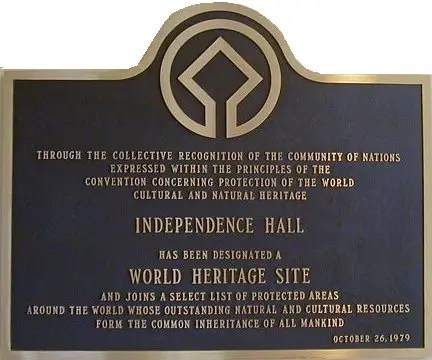
Independence Hall – World Heritage Site
“Through the collective recognition of the community of nations expressed within the principles of the convention concerning protection of the world cultural and natural heritage, Independence Hall has been designated a World Heritage Site and joins a select list of protected areas around the world whose outstanding natural and cultural resources form the common inheritance of all mankind.”
Whew! Where did all that mumbo-jumbo come from? Obviously not from American history or our founding documents.
“Common inheritance of all mankind”? No way. Our Declaration of Independence and Constitution are both uniquely American, written by identifiable Founding Fathers on American soil at known points in time.
Independence Hall “joins a select list of protected areas around the world”? Who decided that Independence Hall should “join” anything? It is a unique American treasure. And who is protecting these “protected areas”?
“Collective recognition of the community of nations”? It’s obvious that all those foreign nations don’t agree with our American Declaration or Constitution or the principles therein.
Since it is impossible to relive history and give the “collective” or the “community of nations” any ownership in the historic events that made Independence Hall an American shrine, we can only deduce that some international entity is asserting a vested interest in the building. Who authorized that?
After all, it would have been a nice accolade and not worthy of particular comment if the Independence Hall plaque merely said, “The United Nations honors the cradle of American freedom, the inspired words of the Declaration of Independence, and the genius of the United States Constitution that has nourished liberty in America for more than two centuries.” But it didn’t.
We now find that at least 20 pieces of American property have been designated as “World Heritage Sites” and so identified with markers. These include Yellowstone and Yosemite national parks, the Grand Canyon, Thomas Jefferson’s home Monticello, and, believe it or not, the Statue of Liberty. All of these markings took place without any publicity, without the American people knowing what was going on.
The designation of these World Heritage Sites was authorized by the World Heritage Convention, a treaty signed by President Nixon and ratified in 1973. The World Heritage Program is carried out by UNESCO, which the United States hasn’t belonged to since President Reagan pulled us out because it was totally corrupt.
The UNESCO Man and the Biosphere Program was created in 1970. The United States joined in 1974 when our State Department signed a memorandum of understanding (not a treaty) to put us in the Biosphere Program and pledge that the United States will adhere to the Biosphere conditions and limitations laid down by UNESCO.
Paragraph 44 of the World Heritage Operational Guidelines states that “natural” Heritage Sites (as contrasted to “cultural”) can be interchanged with “core reserves” of the UNESCO Man and the Biosphere Program. These core protected areas are planned to be surrounded by highly regulated buffer zones, all for the sake of “biodiversity.”
At a conference in Spain in 1995 that culminated in the Seville Strategy, the Biosphere Program underwent a radical change in purpose. The first goal of the Seville Strategy for Biosphere Reserves is to “promote biosphere reserves as a means of implementing the goals of the Convention on Biological Diversity.”
U.S. State Department representatives agreed to this new framework of UNESCO-designated guidelines and objectives for the Man and Biosphere Program. So, even though the United States doesn’t belong to UNESCO, and even though the U.S. Senate refused to ratify the Biodiversity Treaty, the United States is marching right ahead with UNESCO’s Man and the Biosphere Program.
Starting with Yellowstone National Park in 1979, UNESCO has designated 47 Biosphere Reserves in the United States covering 50 million acres. In order to designate sites and spheres under either of these UNESCO programs, the United States must agree to manage these lands according to international dictates and objectives.
That’s another way of saying that the United States has agreed to limit our sovereignty to manage our own lands any way we want in pursuit of our own national interests. The Clinton Administration’s designation of Yellowstone as a World Heritage Site “in danger” has already been used to shut down a gold mine near (not in) Yellowstone.
The UN/UNESCO types have made no secret of their goals. Their next step is their Wildlands Project, a plan to designate one-half of the United States as “protected areas or areas where special measures need to be taken to conserve biological diversity.”
If American citizens are allowed any say so, my guess is that the overwhelming majority would say that we don’t need or want any UN/UNESCO bureaucrats telling us how to “protect” our own land. We can jolly well handle our own protection.