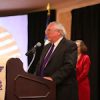
Alabama Chief Justice Roy S. Moore won his seat campaigning as the Ten Commandments Judge, and he has lived up to his billing. On August 1, 2001, he unveiled a magnificent two-and-a-half ton granite tribute to the Ten Commandments and other inspired words in the colonnaded rotunda of the Alabama State Judicial Building.
Shaped like a cube, this four-foot-tall monument displays the Ten Commandments on the top. Each of the four sides of the cube features famous American words: “Laws of nature and of nature’s God” from the Declaration of Independence (1776), “In God we Trust” from our national motto (1956), “One nation under God, indivisible, with liberty and justice for all” from our Pledge of Allegiance (1954), and “So help me God” from the oath of office in the Judiciary Act (1789).
The remaining space on the sides of the cube is filled with quotations from famous Americans such as George Washington, Thomas Jefferson and our first Chief Justice John Jay, from William Blackstone, and from our National Anthem.
The American Civil Liberties Union (ACLU) filed suit to get a court to remove the monument. Several years ago, when Roy Moore was a lower court judge, an ACLU suit failed to get a small hand-carved Ten Commandments plaque removed from his courtroom, but this time, the ACLU found a Jimmy-Carter-appointed federal judge willing to intervene in state court.
Myron H. Thompson was confirmed as a federal judge by the Democratic Senate in 1980, only a few months before the Reagan landslide. If the Republicans had delayed confirmation, a Reagan appointee would have filled the seat Thompson now holds.
Judge Thompson held a week-long trial, ruled the Ten Commandments monument unconstitutional and ordered it removed from the State Judicial Building. It took him 76 pages to present his rationale for this decision in Glassroth v. Moore.
Thompson’s principal argument is that “the Chief Justice’s actions and intentions” violate the Establishment Clause of the First Amendment. Unable to demonstrate that the monument itself violates the First Amendment, Thompson’s decision redundantly rests on Chief Justice Moore’s speeches, writings, intentions, campaign literature, and even his association with Coral Ridge Ministries which filmed the installation of the monument.
Thompson, who personally went to view the monument, pronounced “the solemn ambience of the rotunda,” and the fact that he got the impression there is “a sacred aura” about the monument, as an additional reason why it is unconstitutional. He pretended to see the “sloping top” of the Ten Commandments tablets as unconstitutionally making the viewer think that they are really an open Bible in disguise.
The “air” about the monument that he finds intolerable is augmented, he said, by the fact that it is “in front of a large picture window with a waterfall in the background” so you really can’t miss seeing the monument. Thompson concluded that “a reasonable observer” would “feel as though the State of Alabama is advancing or endorsing, favoring or preferring, Christianity.”
What a non sequitur! There is nothing on the monument about Christianity. Does Thompson think the picture window and the waterfall somehow transform the Ten Commandments, which are Jewish law, into endorsing Christianity?
The most far-out lines in this opinion are Judge Thompson’s repeated references to Chief Justice Moore’s belief in “the Judeo- Christian God.” Thompson accuses Moore of “an obvious effort to proselytize” on behalf of his Judeo-Christian religion and even of being “uncomfortably too close” to supporting the adoption of a “theocracy.”
Judge Thompson is solicitous to prevent anybody from getting the idea that he is against the Ten Commandments. So he patronizingly opines that other Ten Commandments displays on public property are okay because the tablets Moses holds are blank, or the tablets merely show Roman numerals I through X, or the Commandments are inscribed in Hebrew.
It’s hard to see how even Judge Thompson’s “reasonable observer” could think that anything was written on Moses’ tablets except the same Ten Commandments that are on Chief Justice Moore’s monument.
This case has nothing to do with establishing a religion or a church, which the Establishment Clause forbids. The case simply poses the question, does the First Amendment prohibit us from acknowledging God on public property or in a public forum?
As the Ten Commandments monument inscriptions remind us, our nation historically and currently acknowledges God in our Pledge of Allegiance, in our motto, on our money, in our oaths of office, in the Declaration of Independence, and in our National Anthem. This case is similar to the Ninth Circuit U.S. Court of Appeals case which earlier this year ruled (now on appeal) that “under God” in the Pledge of Allegiance is unconstitutional.
The ACLU attorneys who won in Thompson’s court are now demanding that Chief Justice Moore personally pay $704,000 in legal fees. If they really spent that extraordinary sum on this ridiculous case, it just proves how determined the ACLU is to remove all references to God from the public forum.
Share this:
- Share on Facebook (Opens in new window) Facebook
- Share on X (Opens in new window) X
- Share on LinkedIn (Opens in new window) LinkedIn
- More
- Share on WhatsApp (Opens in new window) WhatsApp
- Share on Telegram (Opens in new window) Telegram
- Share on Reddit (Opens in new window) Reddit
- Email a link to a friend (Opens in new window) Email
- Share on Pinterest (Opens in new window) Pinterest
- Share on Tumblr (Opens in new window) Tumblr
- Print (Opens in new window) Print